Introduction
Starting a digital template business sounds simple: create a file, upload it, and sell it. In reality, the businesses that scale do much more than that.
They build systems. They position products well. They reduce buyer uncertainty. They use content to attract the right audience. And they design the business to expand over time.
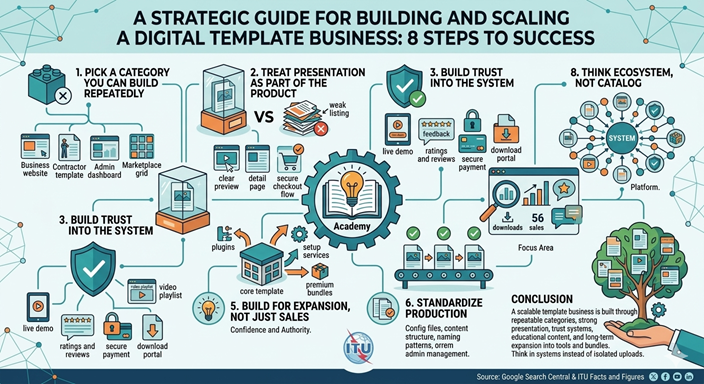
Step 1: Pick a Category You Can Build Repeatedly
Scalable businesses are built on repeatable structure. Choose categories where demand is understandable and production can become more efficient over time.
Examples
- business websites
- contractor templates
- school websites
- marketplace templates
- admin dashboards
The goal is not to make one beautiful item. The goal is to make a category you can keep improving and multiplying.
Step 2: Treat Presentation as Part of the Product
In digital marketplaces, the way a product is presented affects how valuable it feels.
A template with a clean preview, strong detail page, trust signals, and a smooth checkout flow feels more premium than the same template dropped onto a weak listing page.
This is why marketplace design matters so much. Buyers do not judge only the asset. They judge the environment around it.
Step 3: Build Trust into the System
If you want strangers to buy a digital product, the site needs to reduce uncertainty.
Trust elements include:
- clear product descriptions
- live demo access
- ratings and reviews
- secure payment flow
- download access after purchase
These are not “extra features.” They are part of the sales system.
Step 4: Use Learning Content to Drive Demand
One of the smartest ways to scale a digital product business is to teach people how to make better decisions.
That is where blog content and academy content become powerful. They do more than drive traffic. They build confidence and authority.
Examples of useful supporting content
- how to choose a website template
- how to launch a site faster
- how mobile speed affects conversion
- how to structure a small business website
Google Search Central’s SEO guidance emphasizes helpful, well-structured content. That makes educational content useful not only for users but for long-term discoverability as well.
Step 5: Build for Expansion, Not Just Sales
A scalable template business often expands into additional layers.
- plugins
- tool packs
- setup services
- premium bundles
- learning products
When your core template category is strong, these become natural upsells rather than unrelated products.
Step 6: Standardize Production
The businesses that scale usually standardize layout logic, file organization, naming, branding replacement, and page structures.
This matters because scaling is not only about selling more. It is also about producing more efficiently without losing quality.
What to standardize
- config files
- content structure
- logo and favicon replacement points
- page naming patterns
- admin management flow
Standardization turns creativity into a business process.
Step 7: Watch What the Market Rewards
Use reviews, downloads, purchase counts, and buyer questions to decide where to focus next.
Some categories may attract attention but not sales. Others may convert better because the business use case is clearer. Your marketplace data should guide your roadmap.
Step 8: Think Ecosystem, Not Catalog
The strongest digital businesses do not stop at listing products. They connect products, content, and trust mechanisms into one coherent system.
That is how a store starts looking like a platform.
Conclusion
A scalable template business is not built by selling random files. It is built through repeatable categories, strong presentation, trust systems, educational content, and long-term expansion into tools and bundles.
When you think in systems instead of isolated uploads, growth becomes far more realistic.
Sources and Further Reading
- Google Search Central — SEO Starter Guide
- Google Search Central — Documentation to Improve SEO
- ITU — Facts and Figures 2024
Ready to Build Faster?
Explore premium-ready templates, practical business lessons, and marketplace products designed to help you launch with confidence.